How Should the Raw Materials and Binders for Basic Refractory Gunning Mixes be Correctly Selected?
The use of basic refractory gunning mixes to repair steelmaking converters, electric arc furnaces, and ladles while they are in a hot state—thereby extending their service life—has become a widely adopted practice in the global steel industry. It serves as a highly effective technical measure for protecting furnace linings.
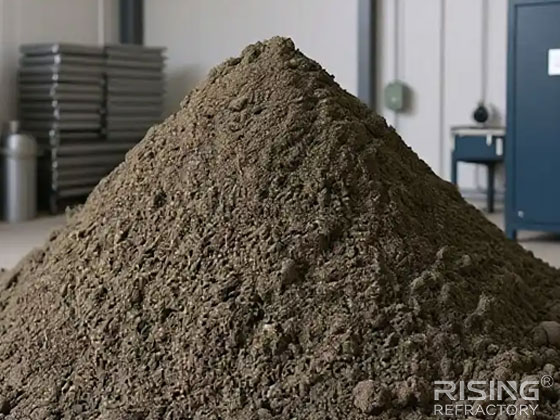
Performance Characteristics of Gunning Mixes
Gunning mixes are essential materials for extending the service life of furnace linings. In general, a gunning mix should possess the following basic properties:
- (1) An adhesion rate of greater than 80%.
- (2) No spalling or cracking of the gunned surface after the first heat of steel is tapped.
- (3) A residual amount of at least 50% on the gunned surface after one heat of operation.
High-quality gunning mixes must meet the following requirements:
- (1) Uniform flow characteristics when passing through gunning equipment.
- (2) Good adhesion, solidification, and hardening properties.
- (3) Minimal rebound (material bounce-back).
- (4) Favorable physical properties for the applied layer (high bulk density, low porosity, and high strength).
- (5) Good sintering capability.
- (6) Excellent refractory performance.
- (7) Strong resistance to erosion.
It is evident that the application performance (adhesion, sintering, etc.) and erosion resistance (slag resistance, wear resistance, etc.) of a gunning mix depend on the composition of the raw materials, the particle size distribution, and the properties of the binder system. Furthermore, the rate of rebound directly impacts economic efficiency.
To obtain a high-performance gunning mix, its properties can be adjusted through three fundamental approaches:
- (1) Careful selection of raw materials.
- (2) Optimization of particle size distribution.
- (3) Selection of an appropriate binder system.
Main Raw Materials for Basic Gunning Mixes
Basic gunning mixes are typically composed of MgO-based or MgO-CaO-based materials, with MgO-based compositions being the most common. To ensure that magnesia-based gunning mixes are both effective and economical, simply choosing the cheapest blend is rarely the best approach. High-quality magnesia-based gunning mixes, combined with modern application techniques, can significantly extend the service life of furnaces in the steel industry without compromising production capacity. Consequently, it is essential to select high-purity raw materials.
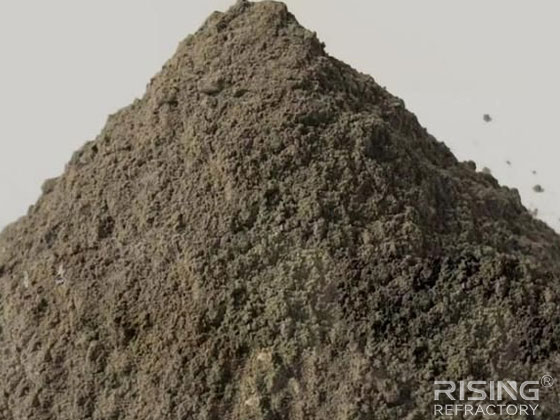
High-grade, phosphate-bonded magnesia gunning mixes generally utilize dead-burned magnesia with an MgO content of approximately 95%–97% and a high CaO/SiO₂ ratio. In cases where the CaO/SiO₂ ratio is low, additional CaO should be incorporated. Under these conditions, it is also critical to ensure that the total content of Fe₂O₃ and Al₂O₃—denoted as Σ(Fe₂O₃+Al₂O₃)—does not exceed 1.5%. For high-quality gunning mixes, this value should be kept below 1.0%.
When using dead-burned magnesia with a CaO/SiO₂ ratio greater than 2—supplemented with CaO-rich dead-burned magnesia—to produce phosphate-bonded gunning mixes, hydration can occur, potentially leading to the spalling of excessively thick gunning layers. Appropriate preventive measures must therefore be taken; surface coating (applied to MgO-CaO grains or CaO-rich dead-burned magnesia) is a particularly effective technique.
High-quality gunning mixes require high-calcium additives to facilitate the formation of high-melting-point phases (such as calcium phosphates or dicalcium silicates), while preventing the creation of low-melting-point silicates. These high-calcium additives, which react with the binder, are most effective when distributed in the form of fine powder.
Gunning mixes designed for long service life should contain free CaO (fCaO) in addition to high-purity raw materials. By incorporating extra calcium, the basicity of infiltrating slag is increased, which helps prevent the formation of low-melting-point silicates caused by the penetration of other phases, thereby extending the service life of the gunned layer.
Theoretically, the additional fCaO is typically introduced in the form of fine sintered dolomite powder. However, given that this material is prone to hydration, the resulting volume expansion can lead to the failure of the gunning layer. Therefore, it is more appropriate to use an MgO-CaO aggregate containing approximately 20% free CaO (fCaO). In this type of MgO-CaO aggregate, the CaO is encapsulated by periclase, which imparts a relatively high resistance to hydration.
Binders and Binder Combinations
The selection of binders for basic hot-gunning mixes must meet the following requirements:
- (1) Optimal adhesion, characterized by rapid hardening and solidification.
- (2) Sufficient strength of the gunning mix throughout the entire temperature range in which chemical bonding is active.
- (3) Minimal reduction in the slag-erosion resistance of the gunning mix caused by the binder.
Typically, gunning mixes utilize chemical binders. Since these binders influence adhesion, they are required to stabilize the gunned layer as quickly as possible. Stabilization can be achieved either physically—by increasing the (apparent) viscosity of the fine-powder/water slurry between the particles—or chemically—by accelerating the solidification reaction. The amount of binder used should be sufficient to keep the gunned layer stable after drying and as the temperature rises, up until the point where sintering occurs, without significantly compromising the layer’s resistance to corrosion.
Common binders include sodium silicate (water glass), phosphates, and composite systems based on these substances.
1. Silicate Binders
Silicates are used as binders in wet-gunning mixes, specifically in the form of water-soluble silicates (water glass). These are cost-effective and widely applicable—notably in the production of special steels (where phosphorus contamination of the molten steel must be avoided). Modern water glass formulations have been developed with optimized dissolution and solidification rates; for instance, using water glass with an SiO₂/Na₂O molar ratio of 2.7 as a binder yields excellent results.
2. Phosphate Binders
Compared to phosphates, silicates (water glass) offer inferior adhesion when used as binders for basic gunning mixes. Furthermore, they exhibit poorer high-temperature strength and thermal shock resistance, leading to limited durability (specifically, poor resistance to erosion by basic slags). This is particularly true when low-grade magnesia is used as the raw material. Extensive research and practical application data indicate that phosphate-based binders are the most ideal bonding systems for basic gunning mixes.
3. Alkali-Silicate-Phosphate Binders
Combining the two aforementioned types of binders results in an alkali-silicate-phosphate composite bonding system. Although this system sets relatively slowly, it yields high high-temperature strength by facilitating the formation of significant quantities of sodium-calcium silico-phosphate (a silicophosphate mineral phase) within the gunning layer. When used in basic oxygen furnaces (BOFs), gunning mixes employing this composite bonding system perform comparably to those using phosphate-based binders. However, this type of mix is particularly well-suited for electric arc furnaces (EAFs), where the lining is subjected to rapid temperature fluctuations—conditions that are especially pronounced near water-cooled panels.
4. Cement-Based Binders
The primary drawbacks of basic gunning mixes that utilize cement-based binders are poor adhesion at high temperatures and inadequate volume stability during rapid heating. These issues can be mitigated by incorporating organic acids; the addition of an organic acid induces flocculation shortly after dispersion, thereby ensuring excellent high-temperature adhesion. Furthermore, the addition of small amounts of a dispersant and an anti-spalling agent can improve volume stability during rapid heating.
Magnesia-based gunning mixes that use high-alumina cement as a binder adhere to the substrate in a plastic state. It can be inferred that when bonding occurs via a liquid-phase intermediate layer, a higher-viscosity layer offers greater resistance to shear stress; this enhances the material’s overall stress resistance and strengthens its bond with the substrate. Consequently, the gunning layer becomes more stable, ultimately resulting in superior durability. Such gunning mixes are particularly well-suited for the repair of localized damage in the linings of steel ladles and secondary refining vessels.
Additionally, there are instances where calcium phosphate, sodium phosphate, and sodium silicate are used in combination, as well as cases involving the combined use of calcium phosphate and aluminum sulfate.
Optimization of Basic Gunning Mix Formulations
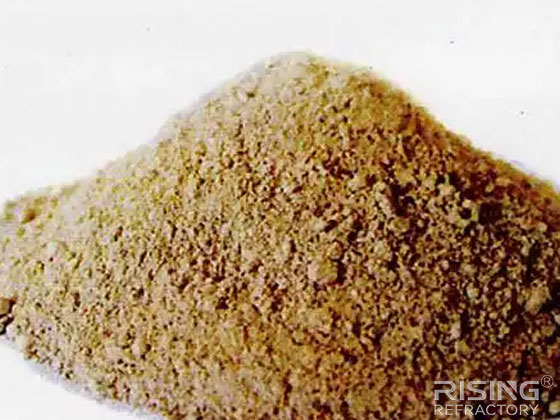
Basic gunning mixes are primarily used for the hot repair of steelmaking equipment; therefore, their formulations must be tailored to the specific steel grades being produced, operational conditions, and the type of equipment. In other words, different gunning mixes should be selected based on the distinct requirements of each application. Users can generally make their selection according to their specific smelting conditions and equipment characteristics.
- (1) Under high-basicity smelting conditions, it is advisable to use phosphate-bonded magnesia-based gunning mixes with a relatively high CaO content (approximately 6%). These materials offer superior resistance to erosion by basic slag and exhibit greater durability compared to silicate-bonded magnesia-based gunning mixes.
- (2) MgO-CaO-based gunning mixes (containing 8%–12% CaO) that utilize a polyphosphate-CaO-SiO₂ binder system provide even greater resistance to basic slag erosion and are, therefore, referred to as “long-life” gunning mixes.
- (3) Magnesia-based gunning mixes bonded with silicates (such as water glass)—produced using high-purity magnesia with a low CaO/SiO₂ ratio—demonstrate excellent resistance to erosion by acidic (low-basicity) slag.
- (4) When magnesia with a low CaO/SiO₂ ratio is used as the raw material, the resulting gunning mixes—regardless of whether a phosphate or silicate binder is employed—exhibit strong and comparable resistance to acidic slag. However, the low CaO content (and the resulting lack of free CaO, or fCaO) slows the curing rate of phosphate-bonded magnesia-based mixes. Consequently, such mixes (derived from low-CaO/SiO₂ magnesia) are difficult to apply in thick layers. This issue can be addressed by incorporating an appropriate amount of a CaO-bearing substance.
- (5) Magnesia-based gunning mixes that employ a composite binder system—consisting of both silicates and phosphates—offer greater versatility and are thus known as “universal” gunning mixes. These mixes are particularly well-suited to the operational conditions of steel ladles.
- (6) Magnesia-alumina gunning mixes—formulated with cement as a binder, an organic acid as a flocculant, and small amounts of a dispersant and an anti-stripping agent—are suitable for localized gunning repairs in secondary refining units and offer good durability.
Based on the above discussion, the following conclusions can be drawn:
- (1) For different applications—such as basic oxygen furnaces (BOFs), electric arc furnaces (EAFs), and ladles—it is necessary to select specific grades and types of basic gunning mixes, tailored to the distinct operating conditions of each.
- (2) In BOFs, phosphate-bonded MgO-based or MgO-CaO-based gunning mixes are typically used to achieve a long service life. However, if the operating temperature is too low, the gunning mix layer may fail to sinter sufficiently and subsequently spall off. In such cases, it is advisable to use an MgO-CaO-based gunning mix with a phosphate-CaO-SiO₂ bonding system, which is better suited to these operating conditions.
- (3) Silicate-bonded MgO-based gunning mixes are primarily used in EAFs and can also be applied in ladles (at moderate temperatures). When high-purity dead-burned magnesia is used as a raw material to enhance corrosion resistance, the binder content should be appropriately increased, and specific additives should be incorporated; otherwise, the gunning mix layer may spall, preventing the desired performance.
- (4) Magnesia-based gunning mixes that utilize a composite binder—consisting of both silicates and phosphates—exhibit high adaptability and can be considered “universal” gunning mixes. These are particularly well-suited to the operating conditions of steel ladles.
- (5) Cement-bonded MgO-Al₂O₃-based gunning mixes, when modified with the addition of flocculants, dispersants, and anti-spalling agents, can also be used in ladles and secondary refining equipment.